计算几何

计算几何

导引问题

求三边形面积:

  • 解析几何里,\(\triangle\text{ABC}\)的面积可以通过如下方法求得:

  • 点坐标 \(\Rightarrow\) 边长 \(\Rightarrow\) 海伦公式 \(\Rightarrow\) 面积

  • 缺点?

  • 计算量大、精度损失,更好的方法?

边的属性

题目:从三个问题谈起

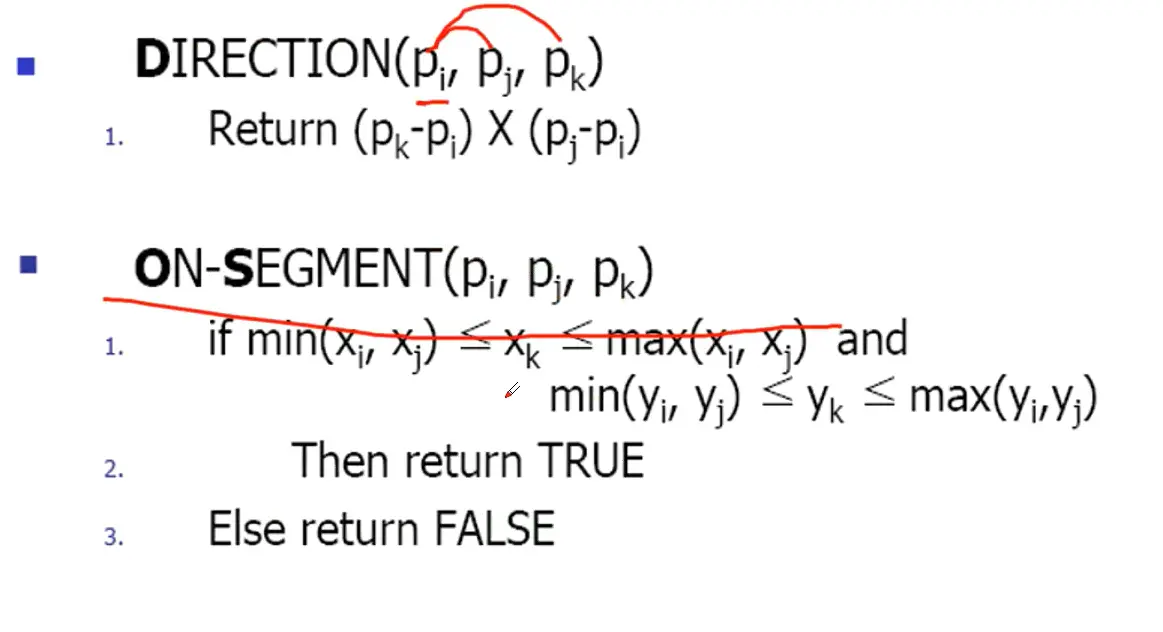
1、给定具有共同端点的两个有向线段\(P_0P_1\)\(P_0P_2\) ,请问——\(P_0P_1\)是否在\(P_0P_2\)的顺时针方向上?

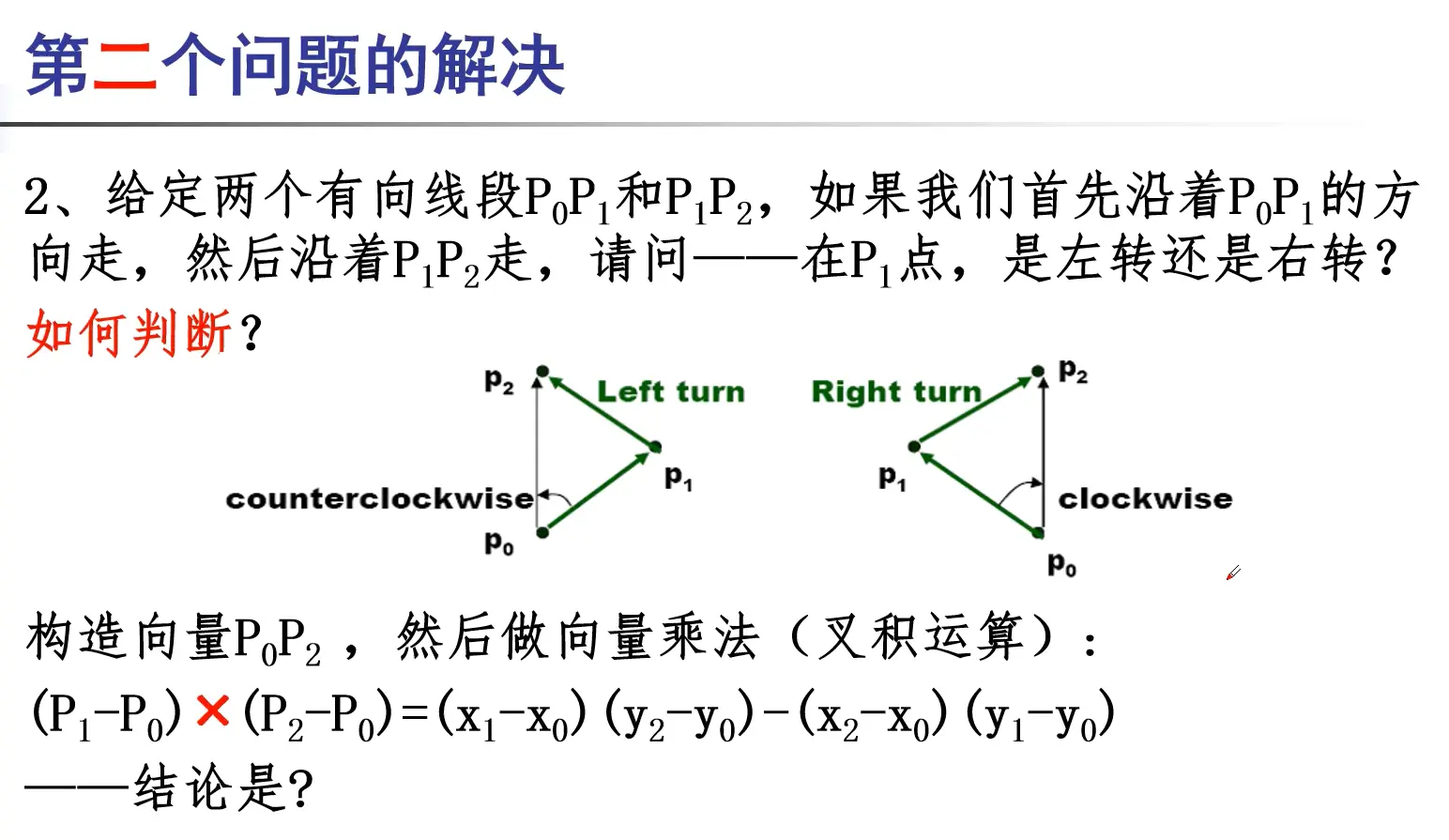
2、给定两个有向线段\(P_0P_1\)\(P_0P_2\),如果我们首先沿着\(P_0P_1\)的方向走,然后沿着\(P_1P_2\)走,请问——在\(P_1\)点,是左转还是右转?

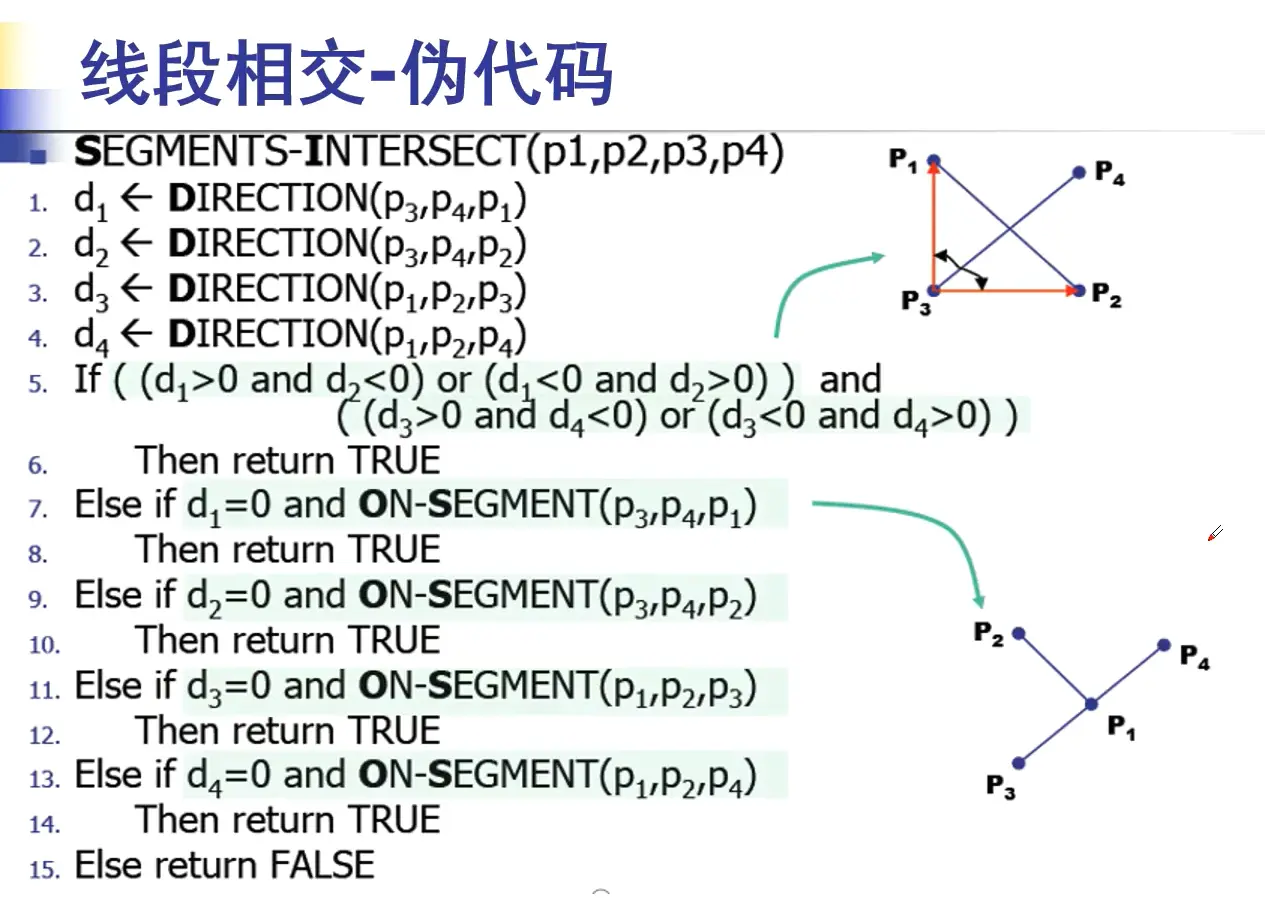
3、给定两个向量\(P_1P_2\)\(P_3P_4\),如何判断它们是否相交?

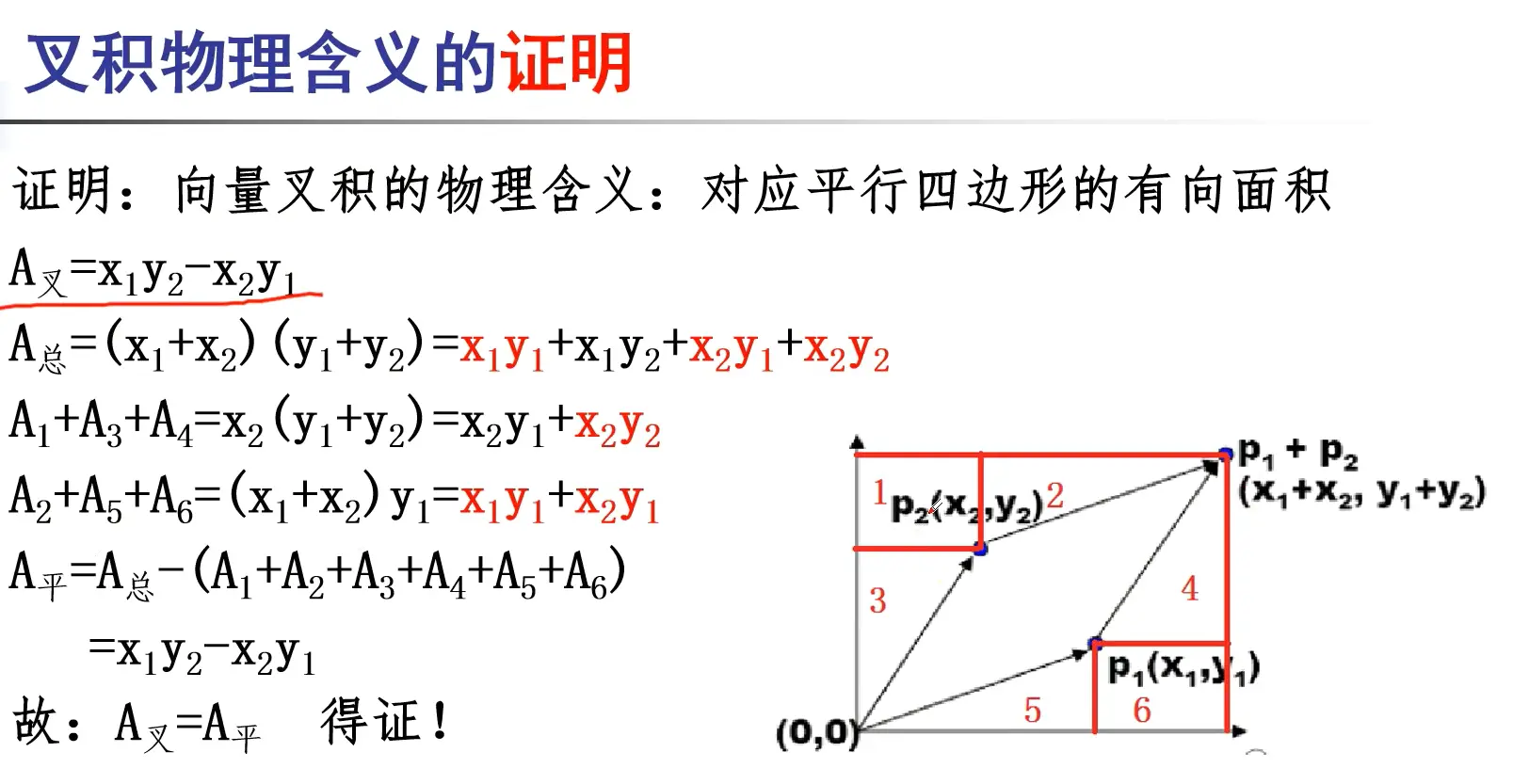
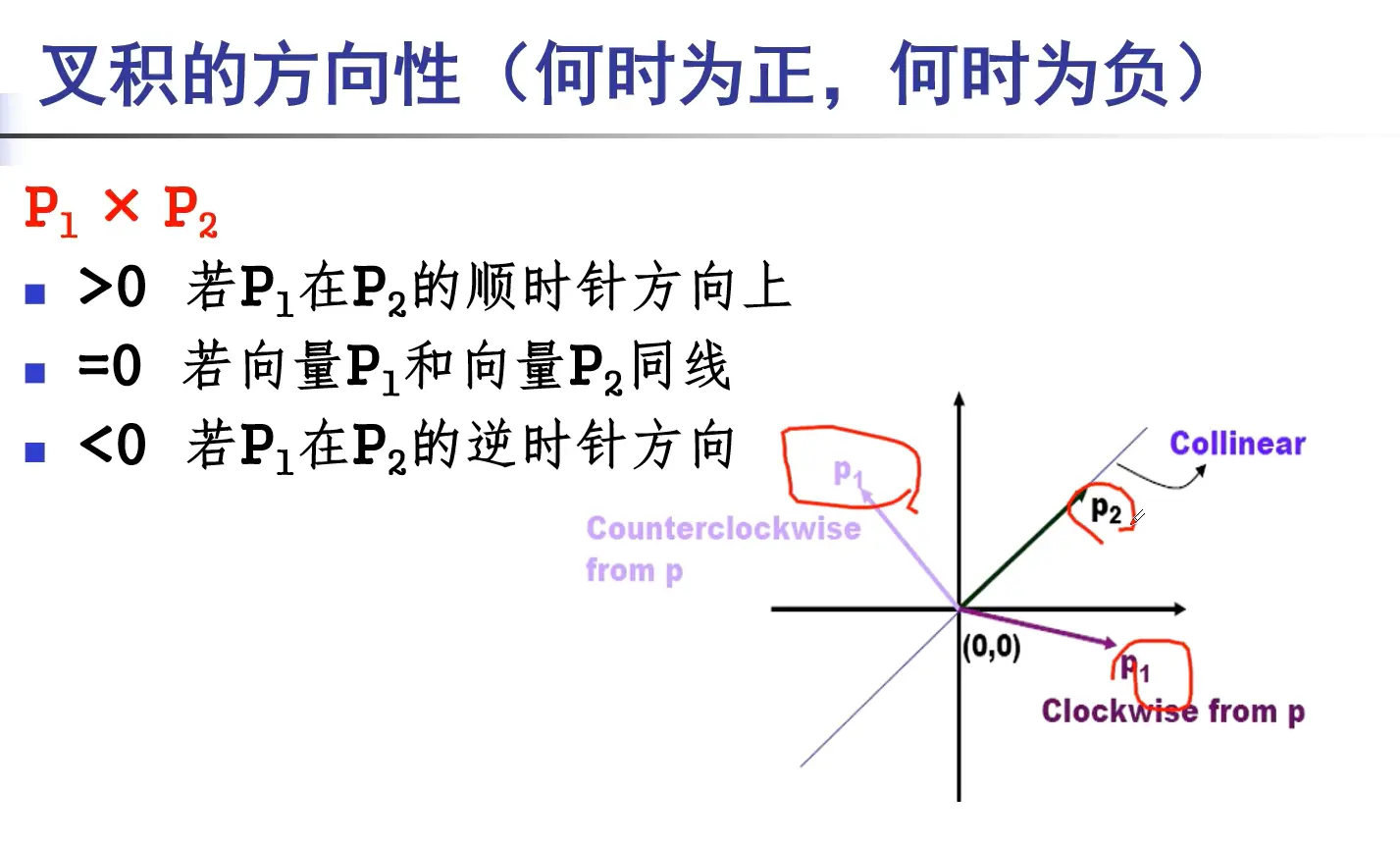
叉乘

问题:是否在顺时针方向上:

转向

交点

方法一 使用解析几何:解方程组+高斯消元,精度低

方法二利用叉乘

x,y 都需要判断,这样可以保证垂直,水平下的特殊情况

交点代码

太疯狂了,总共写了3个多小时 gxx’s Problem

#include <cstdio>
#include <iostream>
#include <cstring>
#include <algorithm>
#include <cmath>
using namespace std;
#define ll long long
#define inf 0x3f3f3f3f

int sign(ll x){
if(x>0){
return 1;
}
else if(x<0){
return -1;
}
return 0;
}

struct frac{
ll z;
ll m;
ll gcd(ll a,ll b){
while(b){
ll r=a%b;
a=b;
b=r;
}
return a;
}
void create(ll a,ll b=1){
ll t=gcd(a,b);
z=a/t;
m=b/t;
if(m<0){
m=-m; z=-z;
}
}
void print(){
if(m==1){
printf("%lld",z);
}
else{
printf("%lld/%lld",z,m);
}
}
};

struct point{
ll x;
ll y;
bool operator ==(const point &p){
return x==p.x && y==p.y;
}
ll cross(const point &p1,const point &p2){
return (p1.x-x)*(p2.y-y)-(p2.x-x)*(p1.y-y);
}
};

struct segment{
point s;
point t;
bool ispoint(){
return s==t;
}
ll cross(point &p){
return p.cross(s,t);
}
bool has(point &p){
if(cross(p)!=0){
return false;
}
if(s.x==t.x){
return p.y<=max(s.y, t.y)
&& p.y >= min(s.y, t.y);
}
else{
return p.x <= max(s.x, t.x)
&& p.x >= min(s.x, t.x);
}
}
bool operator ==(const segment &seg){
return (s==seg.s && t==seg.t) (s==seg.t && t==seg.s);
}
};

int intersection(segment &p1, segment &p2, frac &x, frac &y){
//0 none
//1 one point
//-1 inf
bool isp1=p1.ispoint();
bool isp2=p2.ispoint();
if(isp1 && isp2){
if(p1==p2){
//When 2 segments are the same point.
x.create(p1.s.x);
y.create(p1.s.y);
return 1;
}
else{
return 0;
}
}
else if(isp1 isp2){
if(isp1 && p2.has(p1.s)){
x.create(p1.s.x);
y.create(p1.s.y);
return 1;
}
else if(isp2 && p1.has(p2.s)){
x.create(p2.s.x);
y.create(p2.s.y);
return 1;
}
else
return 0;
}
else{
ll a,b,c,d;
int s1,s2,s3,s4;
s1 = sign(a = p2.cross(p1.s));
s2 = sign(b = p2.cross(p1.t));
s3 = sign(c = p1.cross(p2.s));
s4 = sign(d = p1.cross(p2.t));
if((s1^s2) == -2 && (s3 ^ s4) == -2){
x.create(b*p1.s.x - a*p1.t.x, b-a);
y.create(b*p1.s.y - a*p1.t.y, b-a);
return 1;
}
else if(a==0 && b==0){ //overlay
if(p2.has(p1.s) && p2.has(p1.t)){
return -1;
}
else if(p2.has(p1.s)){//p1's on p2. Here are several cases
if((p1.s==p2.s && !p1.has(p2.t))
(p1.s==p2.t && !p1.has(p2.s))){
//When p1's == p2.s or t but p2 is not on p1
x.create(p1.s.x);
y.create(p1.s.y);
return 1;
}
else
return -1;
}
else if(p2.has(p1.t)){
if((p1.t==p2.t && !p1.has(p2.s) )
(p1.t == p2.s && !p1.has(p2.t) )){
// When p1't == p2.s or t but p2 is not on p1
x.create(p1.t.x);
y.create(p1.t.y);
return 1;
}
else{
return -1;
}
}
else{
if(p1.has(p2.s)){
return -1;
}
else{
return 0;
}
}
}
else if(a==0){//By default, b!=0
if(p2.has(p1.s)){
x.create(p1.s.x);
y.create(p1.s.y);
return 1;
}
else{
return 0;
}
}
else if(b==0){
if(p2.has(p1.t)){
x.create(p1.t.x);
y.create(p1.t.y);
return 1;
}
else{
return 0;
}
}
else if(c==0){
if(p1.has(p2.s)){
x.create(p2.s.x);
y.create(p2.s.y);
return 1;
}
else{
return 0;
}
}
else if(d==0){
if(p1.has(p2.t)){
x.create(p2.t.x);
y.create(p2.t.y);
return 1;
}
else {
return 0;
}
}
else{
return 0;
}
}
}

int main(){
int t;
cin>>t;
frac x,y;
int flag=0;
segment ab,cd;
while(t--){
scanf("%lld %lld %lld %lld",&ab.s.x,&ab.s.y,&ab.t.x,&ab.t.y);
scanf("%lld %lld %lld %lld",&cd.s.x,&cd.s.y,&cd.t.x,&cd.t.y);
flag= intersection(ab,cd,x,y);
if(flag==1){
printf("1\n");
x.print(),printf(" "),y.print();
printf("\n");
}
else if(flag==0){
printf("0\n");
}
else {
printf("INF\n");
}
}
return 0;
}

叉乘:没有除法和开根号,避免传统方法的精度问题

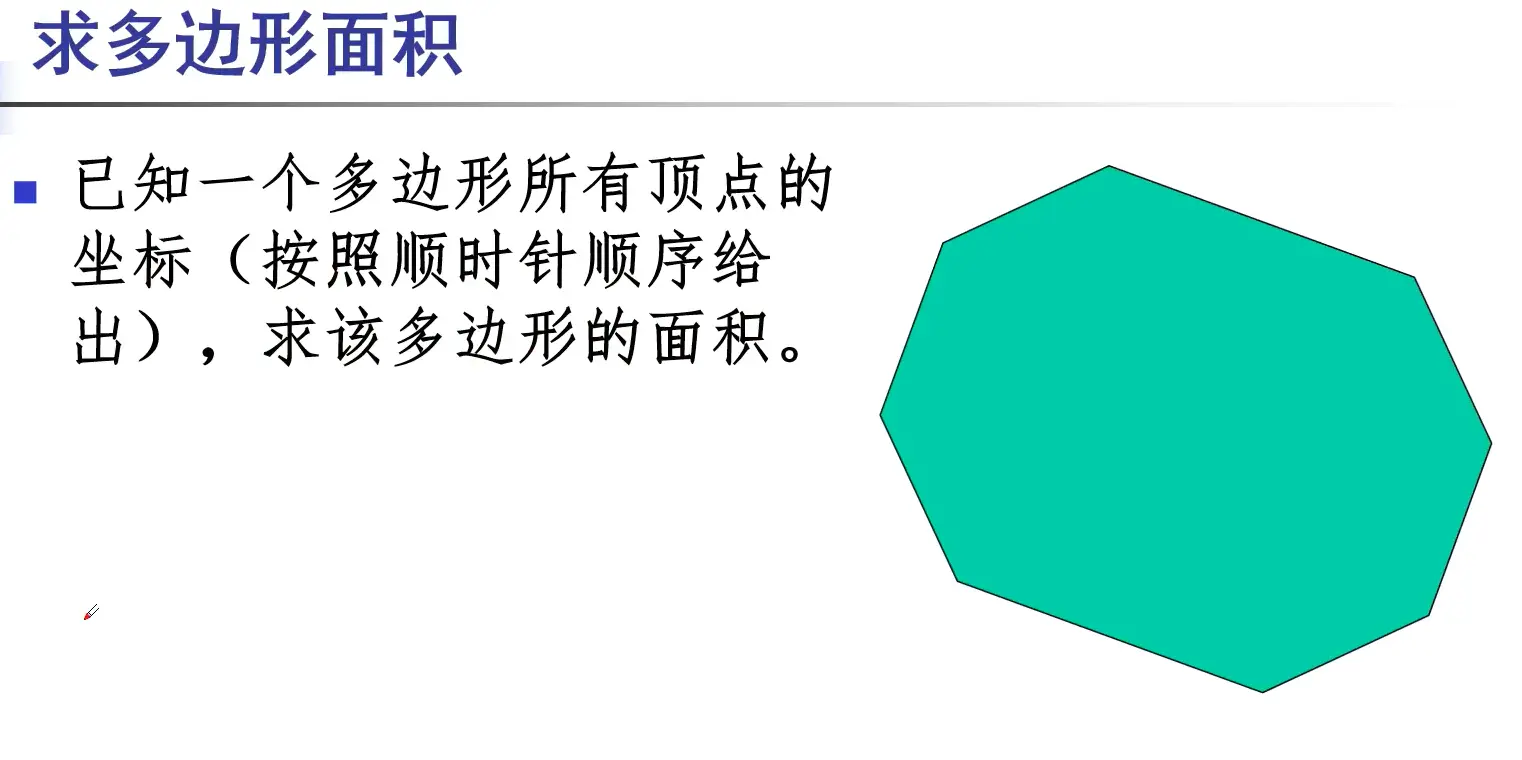
多边形面积

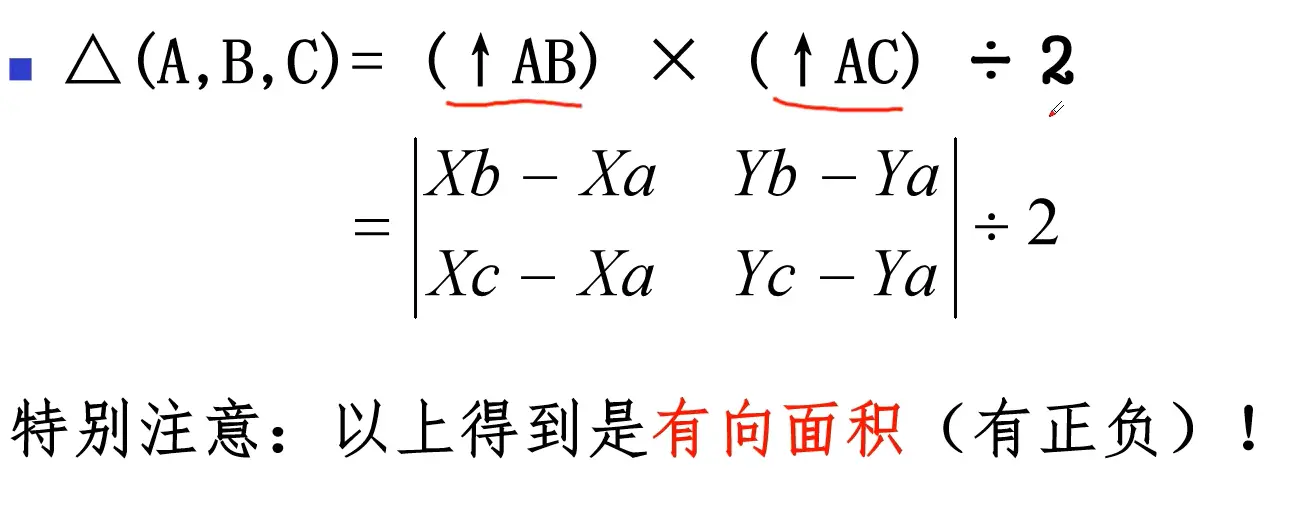
三角形面积:叉乘二分之一

abs绝对值

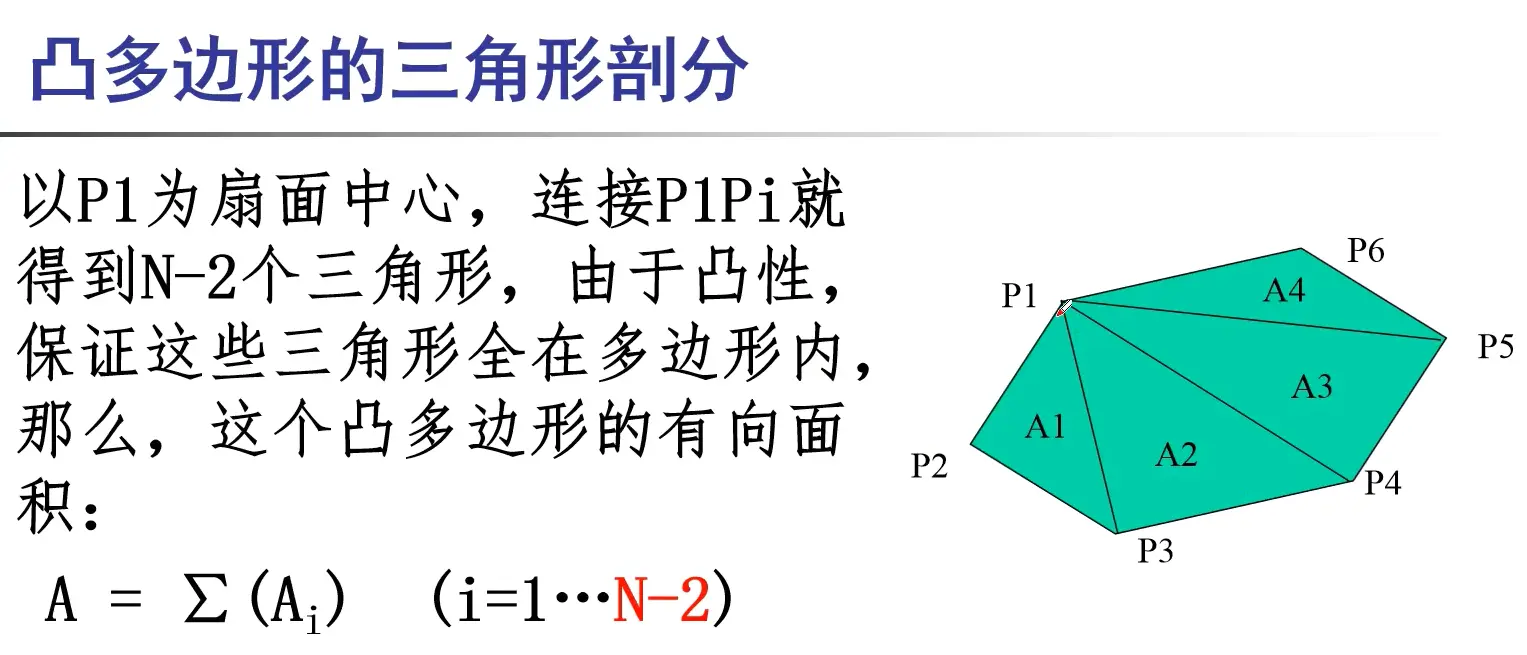
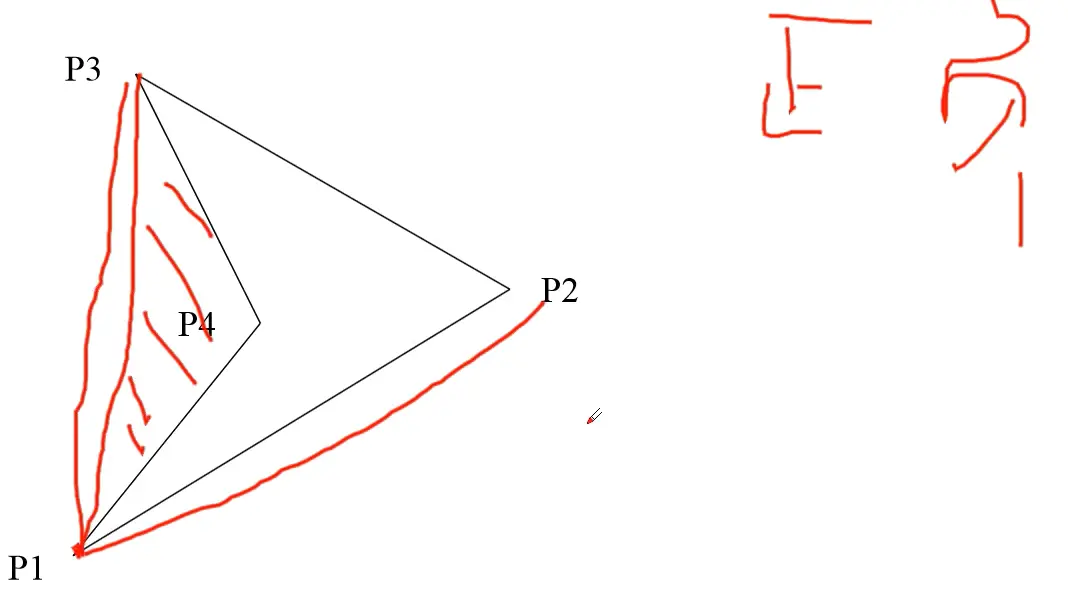
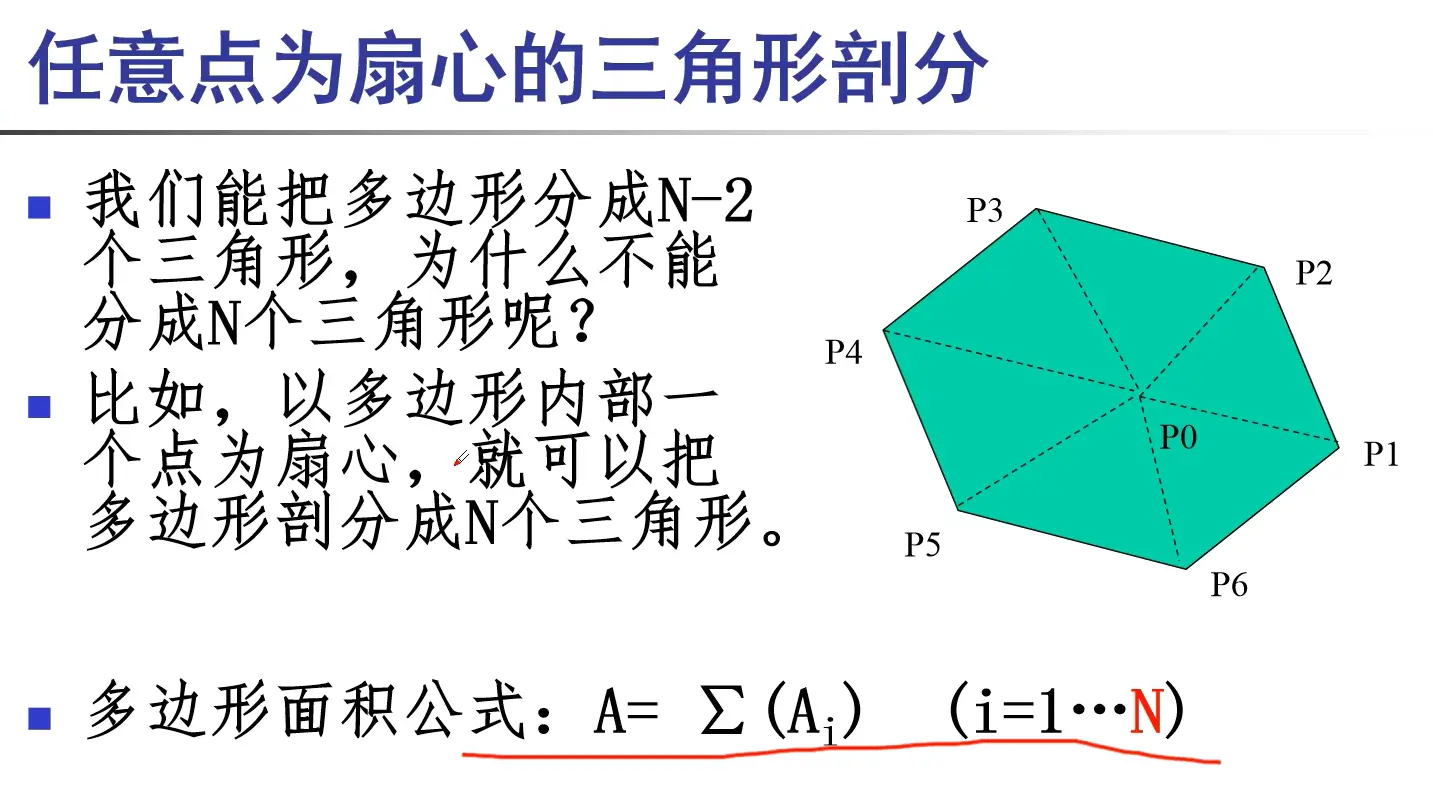
凸多边形分割为三角形

凹多边形面积

先判断凹凸性:依次相叉乘

公式也成立(忽略符号的情况下)

依然成立!!!

多边形面积公式:\(A = \sum (A_i) \ (i=1 \cdots N-2)\)

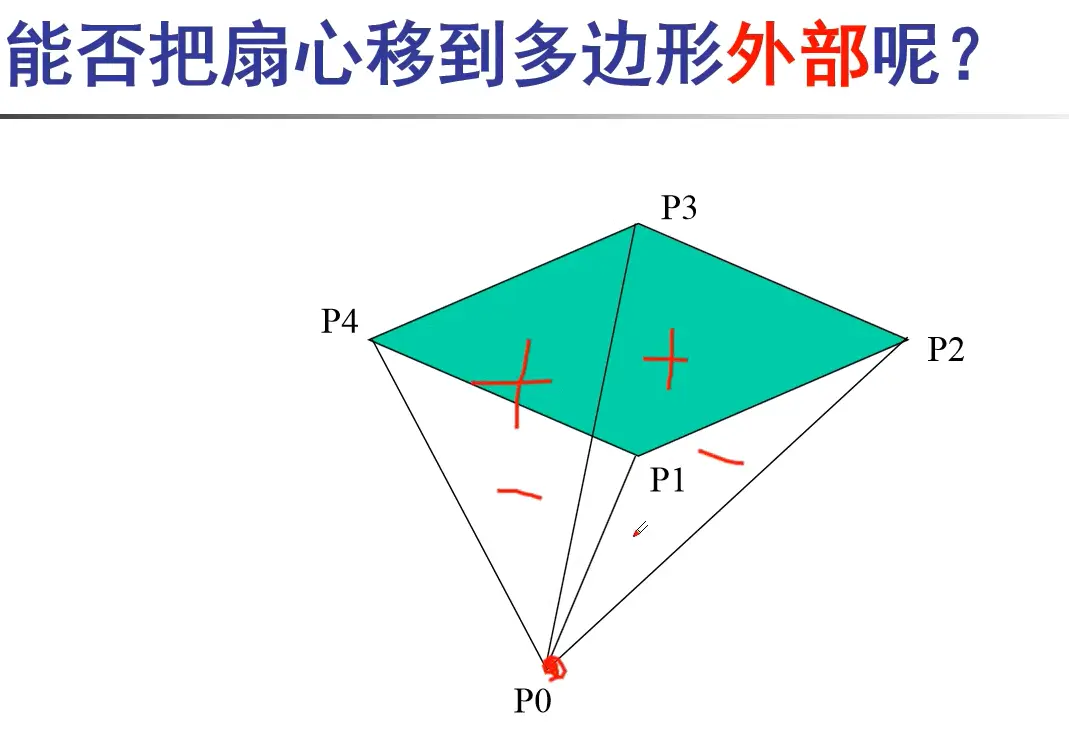
结论:“有向面积”\(A\)比“面积”\(S\)其实更本质!

中间点

外部点

公式依然成立

原点剖分(荐

方便直接可用

简化的公式

\[ A = \frac{1}{2} \sum_{i=1}^{N} \begin{vmatrix} X_i & Y_i \\ X_{i+1} & Y_{i+1} \end{vmatrix} \quad (i = 1 \dots N) \]

多边形重心

求多边形重心

  • 给定一个简单多边形,求其重心。
  • 输入:多边形(顶点按逆时针顺序排列)
  • 输出:重心点C的坐标
  • 三角形的重心公式是?
  • \(x_0=(x_1+x_2+x_3)/3\)
  • \(y_0=(y_1+y_2+y_3)/3\)

处理方式将处理成三角形重心,然后加权

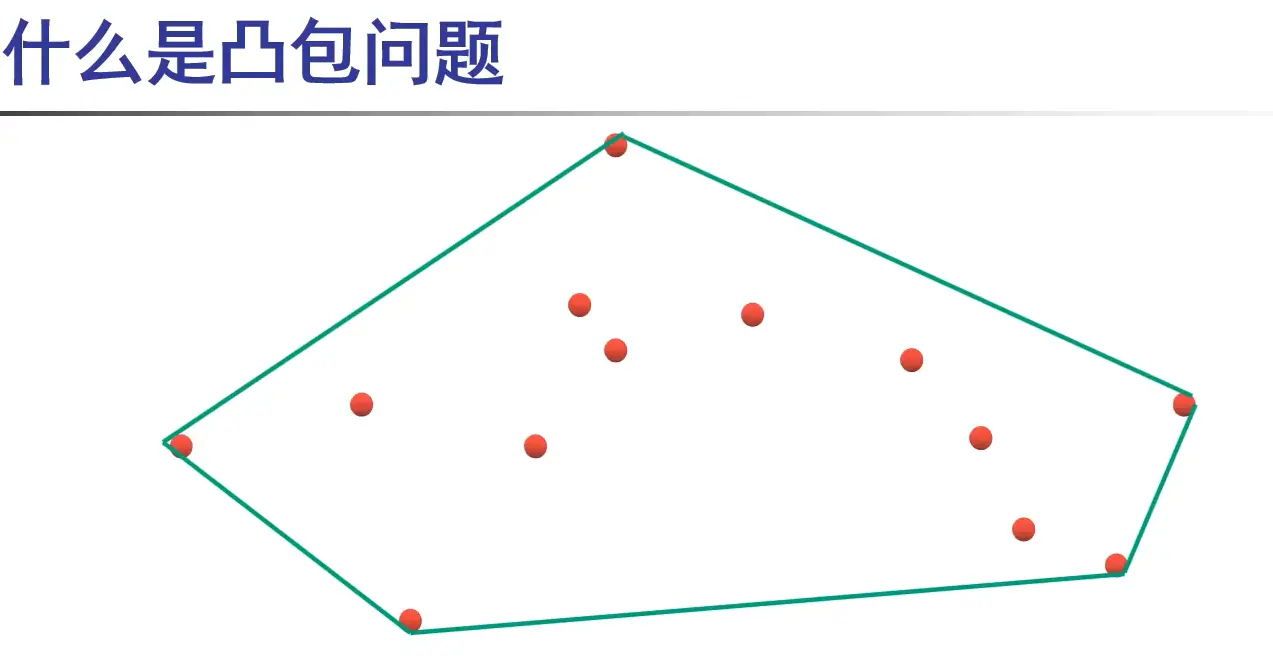
凸包

围绳子

凸包上的点一定是原来就有的点,凸多边形

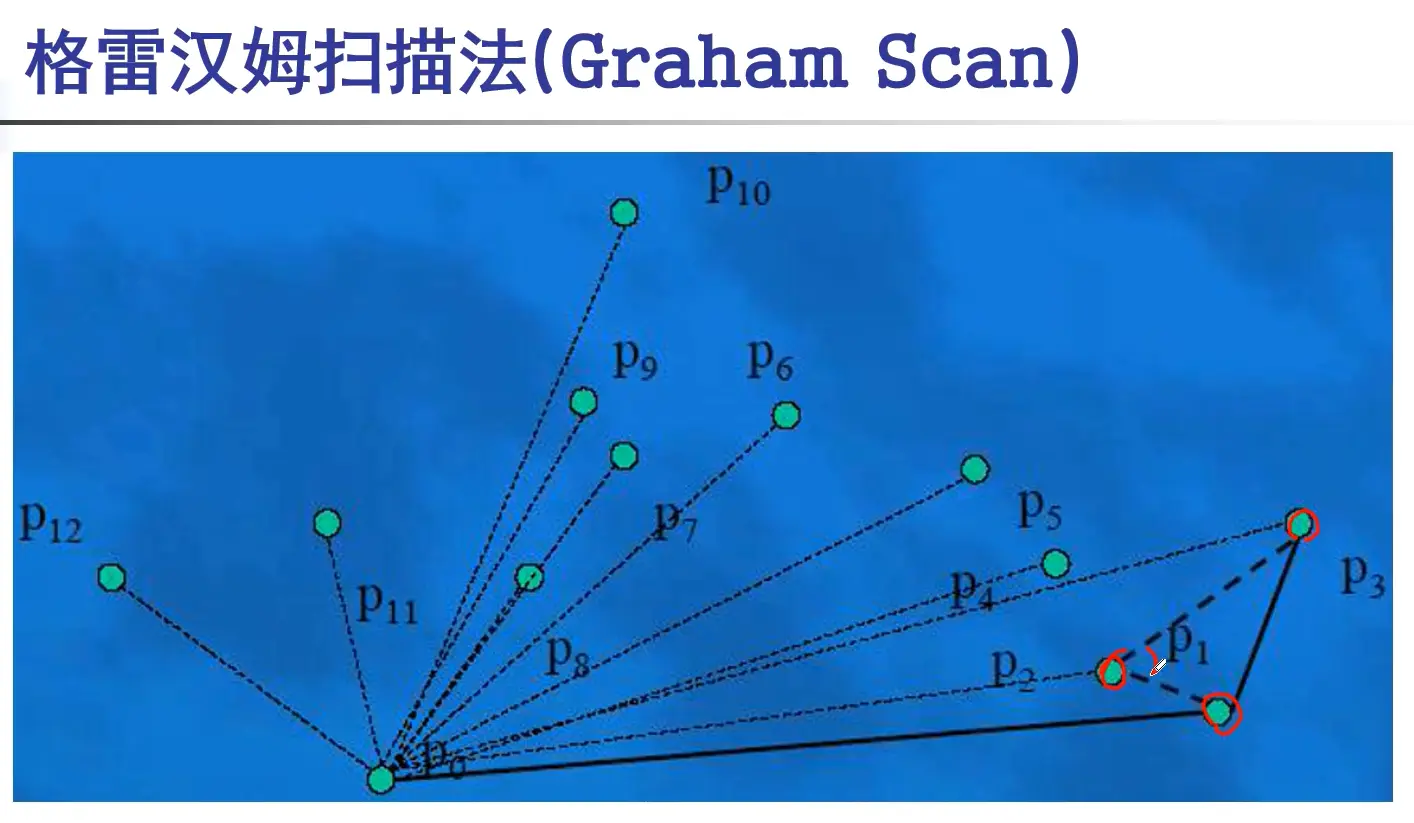
Graham Scan扫描法

选定一个y最低的点,按与X轴的角度sort排序叉乘比较(p1,p2)叉乘比较相对大小

判断左右转

凸包代码

#include <cstdio>
#include <iostream>
#include <cstring>
#include <algorithm>
#include <cmath>
#include <queue>
#include <stack>
using namespace std;
#define ll long long
#define inf 0x3f3f3f3f

struct node{
ll x;
ll y;
}tree[10010];

void swapnode(node &p1,node &p2){
node p3=p1;
p1=p2;
p2=p3;
return ;
}

ll cross(node tree,node p1,node p2){
return (p1.x-tree.x)*(p2.y-tree.y)-
(p2.x-tree.x)*(p1.y-tree.y);
}

bool cmp(node p1,node p2){
ll sum=cross(tree[0],p1,p2);
if(sum>0 ){
return true;
}
return false;
}

double dis(node p1,node p2){
return sqrt((p1.x-p2.x)*(p1.x-p2.x)+(p1.y-p2.y)*(p1.y-p2.y));
}

int main(){
int n;
while(cin>>n,n){
double ans=0;
memset(tree,0,sizeof(tree));
int pos=0;
ll miny=inf;
for(int i=0;i<n;i++){
ll x,y;
scanf("%lld%lld",&x,&y);
tree[i].x=x;
tree[i].y=y;
if(y<miny){
miny=y;
pos=i;
}
}
if(n==1){
cout<<0<<endl;
continue;
}
else if(n==2){
printf("%.2lf\n",dis(tree[0],tree[1]));
continue;
}
swapnode(tree[0],tree[pos]);
tree[n]=tree[0];
sort(tree+1,tree+n,cmp);
// //testsort:::
// for(int i=0;i<n;i++){
// cout<<tree[i].x<<" "<<tree[i].y<<endl;
// }
// cout<<"END"<<endl;

stack<node> s;
s.push(tree[0]);
s.push(tree[1]);
for(int i=2;i<=n;i++){
node p3=tree[i];
node p2=s.top();
s.pop();
node p1=s.top();
s.pop();
bool flag=false;
// printf("shuzi::%lld %lld %lld %lld %lld %lld\n",p1.x,p1.y,p2.x,p2.y,p3.x,p3.y);
// cout<<"cross::"<<cross(p2,p3,p1)<<endl;
while(cross(p2,p3,p1)<0){
if(s.empty()){
s.push(p1);
s.push(p3);
flag=true;
break;
}
p2=p1;
p1=s.top();
s.pop();
}
if(flag){
continue;
}
s.push(p1);
s.push(p2);
s.push(p3);
}
//testSTACK:::
// while(s.size()!=0){
// cout<<s.top().x<<" "<<s.top().y<<endl;
// s.pop();
// }

while(s.size()!=1){
// cout<<s.top().x<<" "<<s.top().y<<endl;
node p1=s.top();
s.pop();
node p2=s.top();
ans+=dis(p1,p2);
}
printf("%.2lf\n",ans);
}
return 0;
}

伪代码

procedure GrahamScan(set Q)
let p₀ be the point with the minimum y-coordinate
let <p₁, ..., pₘ> be the remaining points in Q, sorted by the angle in counterclockwise order around p₀
Top(S) ← 0
Push(p₀, S); Push(p₁, S); Push(p₂, S)
for i ← 3 to m do
while the angle formed by points NextToTop(S), Top(S) and pᵢ makes a non-left turn do
Pop(S)
Push(pᵢ, S)
return S

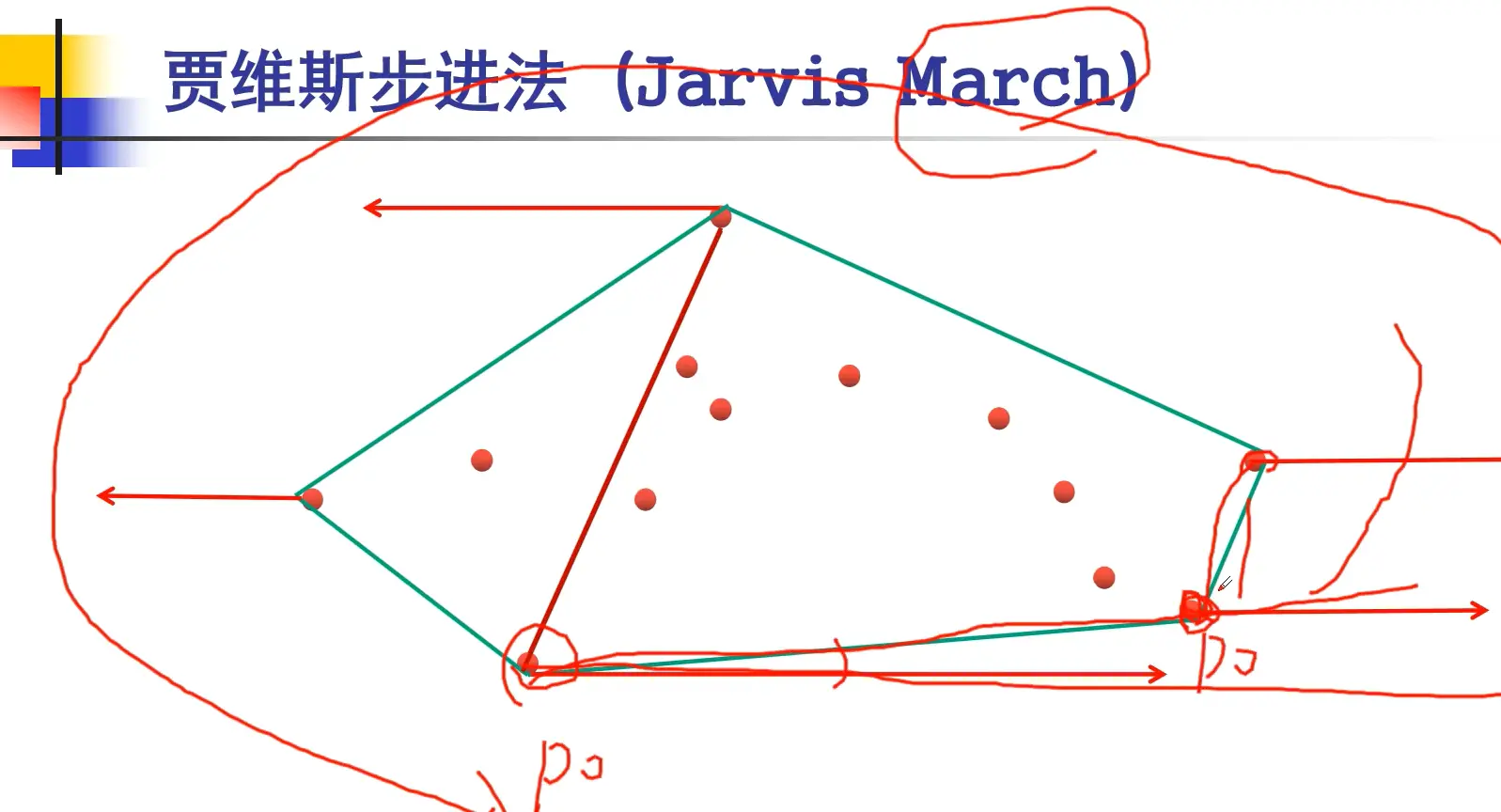
Jarvis March步进法

如同拉一根长的绳子,每次看角度最小的

计算几何卡精度,需要选一个人进行操作,考精度和运气,一般放在最后